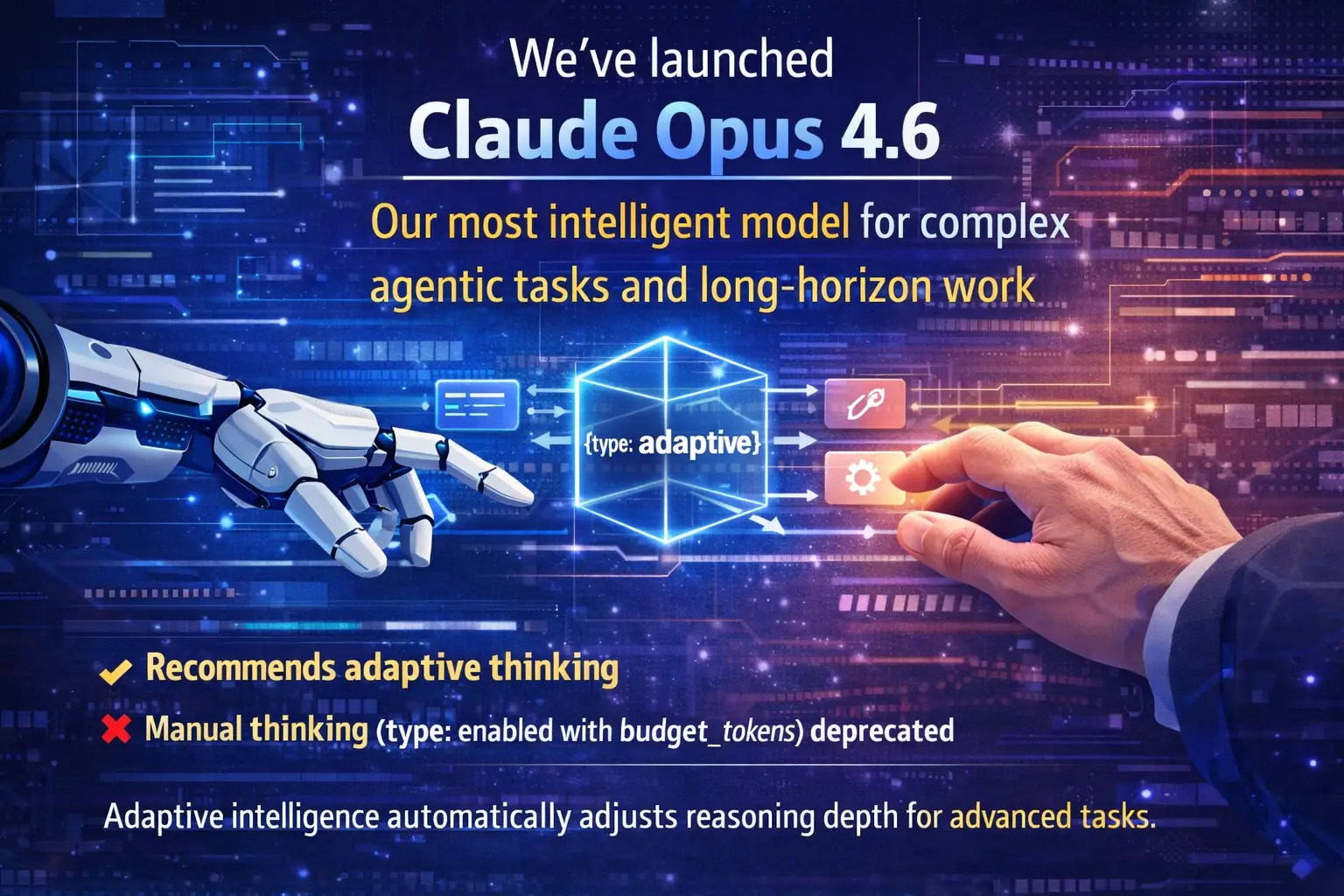

Artificial Intelligence is evolving at an incredible pace, and the latest breakthrough comes from Anthropic with the release of Claude Opus 4.6.
This new model is designed to handle complex agentic tasks and long-horizon work, introducing smarter reasoning capabilities through a new concept called adaptive thinking.
For developers, businesses, and researchers, this update marks a major shift in how AI systems operate and make decisions.
What Is Claude Opus 4.6?
Claude Opus 4.6 is the latest and most intelligent AI model from Anthropic. It is built to perform advanced reasoning tasks that require multi-step planning, complex analysis, and long-term problem solving.
Unlike earlier AI models that required strict instructions, Opus 4.6 is designed to adapt its thinking process dynamically based on the context of the problem.
This makes it particularly powerful for:
Software development
AI agent workflows
Research and analysis
Strategic planning tasks
Automation systems
The Introduction of Adaptive Thinking
One of the most important changes in Claude Opus 4.6 is the shift toward adaptive thinking.
Instead of forcing developers to manually configure how the AI reasons about problems, Opus 4.6 automatically adjusts its reasoning strategy depending on the complexity of the task.
Developers can now use:
This allows the model to determine the optimal reasoning depth on its own, improving efficiency and output quality.
Manual Thinking Mode Is Deprecated
Previously, developers could control the AI’s reasoning through a manual mode using token limits.
Example:
However, this manual thinking configuration is now deprecated.
Anthropic recommends moving entirely to adaptive thinking, which removes the need for developers to manage reasoning budgets manually.
This simplifies AI development workflows and improves performance across complex tasks.
Why This Update Matters
Claude Opus 4.6 represents a major advancement in agentic AI systems.
Agentic AI refers to AI systems that can independently perform tasks, make decisions, and coordinate workflows.
With adaptive thinking, AI can now:
Break down large problems automatically
Plan long multi-step workflows
Adjust reasoning based on new information
Improve problem-solving accuracy
This is especially useful for industries relying on automation and AI-driven decision making.
Impact on Developers
For developers, this update changes how AI is integrated into applications.
Instead of designing complicated prompt structures, developers can rely on the AI’s adaptive reasoning.
Benefits include:
Faster AI integration
Reduced prompt engineering complexity
Better results for large-scale tasks
Improved reliability in autonomous agents
This makes Claude Opus 4.6 particularly valuable for AI-powered platforms, coding tools, and enterprise automation systems.
The Future of AI Reasoning
The move toward adaptive thinking reflects a broader trend in AI development: making systems more autonomous and intelligent.
Rather than acting like simple tools, advanced AI models are beginning to behave more like collaborative problem solvers.
Claude Opus 4.6 is a step toward a future where AI systems can manage long-term goals, execute complex strategies, and assist humans in ways that were previously impossible.
Final Thoughts
The launch of Claude Opus 4.6 shows how quickly AI capabilities are evolving.
With adaptive thinking replacing manual reasoning controls, developers can build more powerful and intelligent applications with less complexity.
As AI continues to advance, tools like Claude will play an increasingly important role in software development, automation, research, and decision making.
The future of AI is not just about generating answers — it is about thinking, planning, and solving complex problems intelligently.









No Comments
Leave a comment Cancel