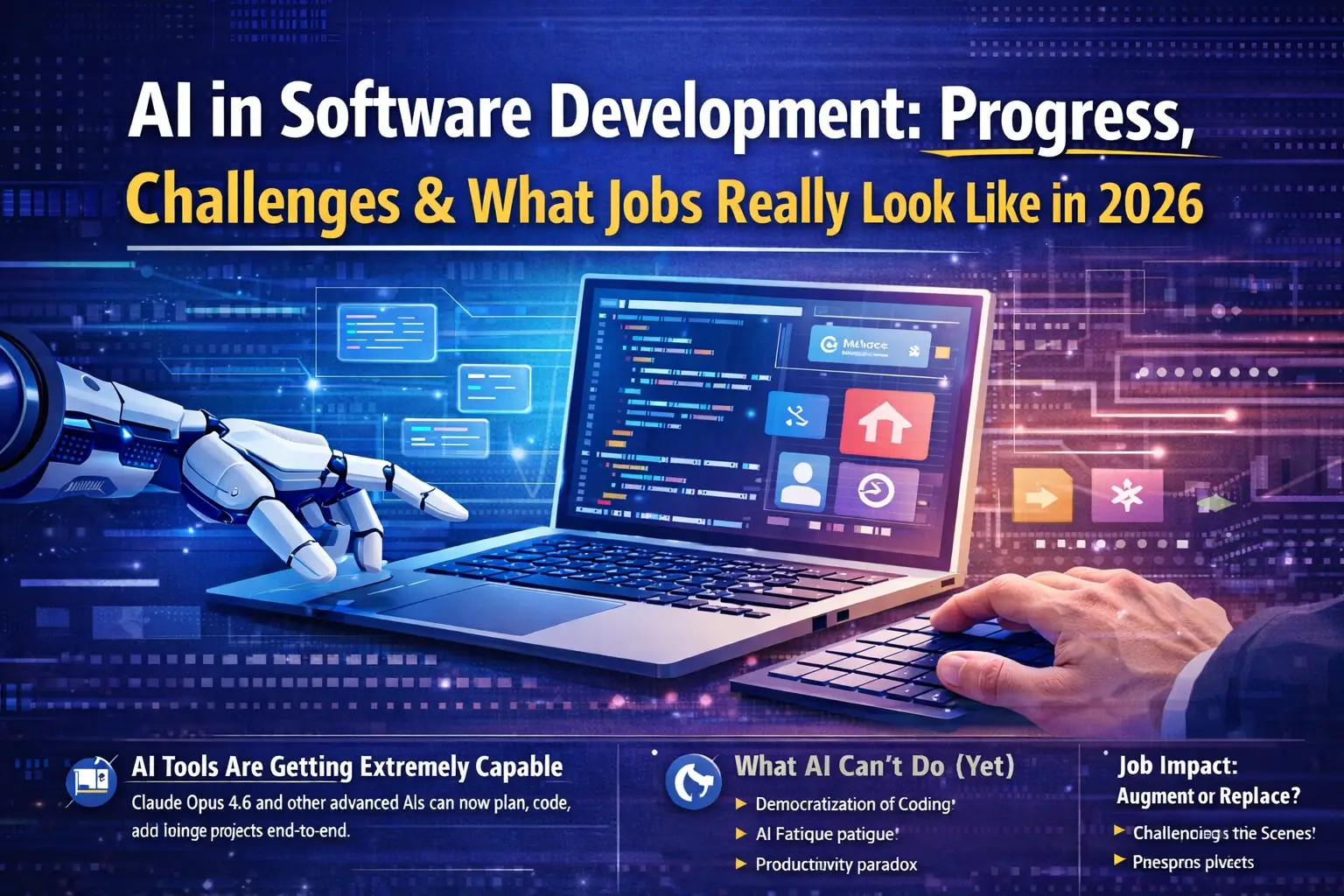

Artificial Intelligence is no longer just assisting developers — it is now writing code, building applications, debugging systems, and even managing workflows.
With the latest release of Anthropic’s advanced AI model Claude, the software industry is entering a new era where even non-programmers can build functional applications.
But what does this mean for software jobs?
Is AI replacing developers — or redefining them?
Let’s explore.
🚀 AI Coding Tools Are Becoming Extremely Powerful
Modern AI models can now:
Write full-stack applications
Debug complex code
Generate APIs
Refactor legacy systems
Explain large codebases
Automate documentation
The newest versions of Claude and similar AI tools can understand bigger contexts, multi-file projects, and structured workflows.
This is no longer autocomplete.
This is AI-powered development assistance at scale.
👨💻 Coding is Now for Everyone (Democratization of Development)
AI has lowered the barrier to entry.
Today:
Business owners can generate websites
Students can build apps without formal training
Non-technical founders can prototype SaaS products
Freelancers can deliver projects faster
This trend is often called “vibe coding” — where you describe what you want, and AI builds it.
✅ The Opportunity
More innovation. Faster MVPs. Lower development costs.
⚠️ The Risk
Entry-level developers may face increased competition as AI handles basic coding tasks.
🤖 What AI Still Cannot Do (Yet)
Despite rapid advancements, AI still struggles with:
Deep architectural decisions
Long-term scalability planning
Complex system integrations
Security auditing
Understanding business logic beyond surface-level prompts
Human creativity and innovation
AI generates code — but experienced engineers ensure it works properly in real-world production environments.
📉 Are Software Jobs at Risk?
The short answer: Some are evolving.
🔻 Roles Most Affected
Junior developers
Basic frontend/backend coders
Simple CRUD application developers
🔺 Roles Growing in Demand
AI-integrated developers
Software architects
DevOps engineers
Cybersecurity experts
AI workflow specialists
Prompt engineers
Instead of replacing developers completely, AI is shifting the job description.
Developers are becoming:
System designers
AI supervisors
Code reviewers
Automation architects
😓 Hidden Challenges of AI in Software Development
1️⃣ AI Fatigue
Reviewing AI-generated code can be mentally exhausting.
2️⃣ Productivity Paradox
AI may speed up coding — but debugging AI-generated errors can take longer.
3️⃣ Skill Erosion
Over-reliance on AI can weaken fundamental programming skills.
4️⃣ Security Concerns
AI-generated code may introduce hidden vulnerabilities if not properly reviewed.
🌍 The Future of Software Careers in 2026 and Beyond
The future is not “AI vs Developers.”
It is:
AI + Skilled Developers
The most successful professionals will be those who:
Understand AI tools deeply
Know when NOT to rely on AI
Combine human creativity with automation
Continuously upgrade their technical skills
AI will not eliminate strong engineers.
It will eliminate outdated skill sets.
🎯 Final Thoughts
The release of powerful AI coding models like Claude marks a turning point in software development.
Coding is becoming more accessible.
But expertise, architecture, and strategic thinking remain human strengths.
The real challenge is not AI replacing jobs —
It is developers adapting fast enough to stay ahead.























People reacted to this story.
Show comments Hide comments55jili, baby! Ready to roll the dice. Hope this site brings better luck than my last one. Time to see what 55jili’s all about. Good luck to me on 55jili.